Saturday, March 3, 2012

Exercise 4-2: Elasticity and Revenue

This week's Exercise is about the relationship between demand elasticity and total revenue. I found an interesting article, about the demand elasticity of hotel rooms. See article on hotelnewsnow.com here.
A study conducted by the Hospitality Sales and Marketing Association International found that discounted hotel room rates do not stimulate enough additional demand to make up for the rate reduction.
In the article, there aren't too many actual numbers available, so I have made up some fictional numbers to graph and demonstrate the situation described in the article.
I have assumed that there are 1000 hotel rooms available at a certain location. As suggested in the article, if a hotel room would cost $1, everyone would suddenly want to stay in a hotel and demand would exceed the 1000 available rooms. Therefore, total revenue would be $1000 at a room price of $1, since every single room would be occupied.

The study found, that demand for hotel rooms is fairly inelastic. This means, as hotel room prices drop, demand doesn't raise significantly. Unless, of course, it comes to the $1 a room extreme. This conclusion tells us, that customers often don't have too many substitutes available. If a business men is on a business trip, chances are he doesn't know anybody in the city he has to stay in, and he probably doesn't want to sign a lease agreement or buy a house for just a couple of days... Most likely renting a camper or using a tent is also not a very convenient option either. So at the end of the day, a hotel room is his only option, at whatever rate the hotels currently charge.

I have assumed the following demand and prices:
Price: Demand:
$50 600
$100 590
$150 580
$200 560
$250 530
$300 490
$350 450
$400 410
$450 380
$500 10

These graphs show the total revenue at the different price and demand levels I have used above:
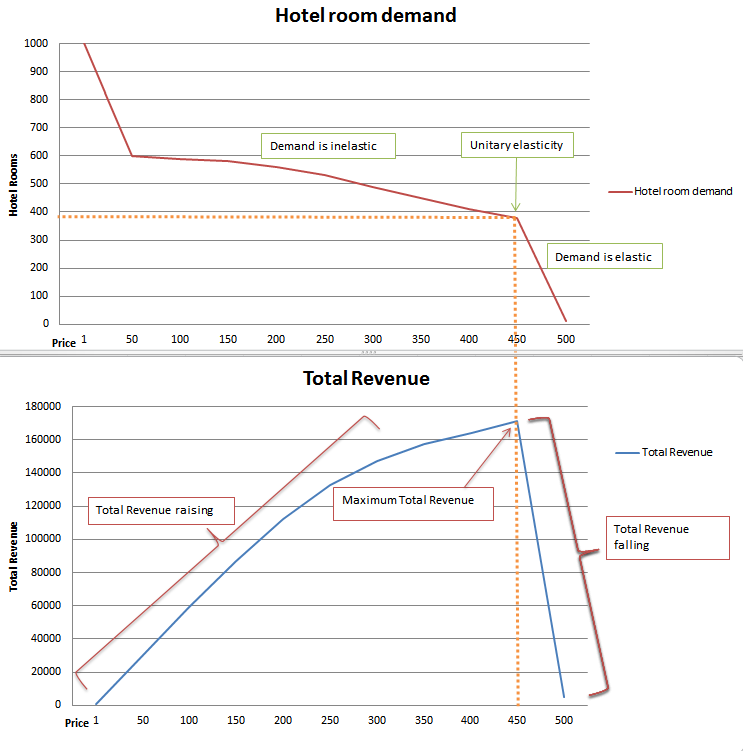

This graph shows us, that if my assumptions would be true, the hotels total revenue would increase as hotel rates increase, since demand is inelastic up to the point of around $450 per room. If hotels would be charging above the $450, demand drops.
A possible reason could be, that customers would rather rent a car and stay in a city a couple hours away from our "test region". Or now, customers rather sign an apartment lease agreement for a month, than staying in hotel for the price of $450 a night.

Saturday, February 25, 2012

Exercise 3-2: Market Equilibrium


This weeks Assignment was to answer a self-test problem given in our textbook "Principles of Microeconomics" Edition 6 by Sayre and Morris.
The idea was to get a graph, showing the shortage and surplus of eggs demanded and supplied, in hundreds per day. Given were the following information:

Price: Quantity demanded: Quantity supplied:
$2.00 60 30
$2.50 56 36
$3.00 52 42
$3.50 48 48
$4.00 44 54


Obviously, the market would be at an equilibrium at a price of $3.50. At this price, demand equals supply at 4,800 eggs. If the price would go above $3.50, there would be a surplus, as more eggs get supplied than demanded. On the other extreme, as the price drops below $3.50, there will be a shortage in eggs, as the demand will increase and the supply decrease.

The graph, displaying this information would look like this:


I have also added a second graph, showing the shortage or surplus at each price:


Tuesday, February 14, 2012

Exercise 2-2: Game on - The McDonalds game

This week's assignment is actually a lot of fun. I enjoyed playing the McDonald's game.
I will obviously keep on playing all week as other students post their results. I did already learn some things, and I like to share a tip with you guys:
Watch your cows as they grow on the grass! One mistake I made at the beginning which led to:
was I didn't watch the ground going bad (as you can see in the background). So the second time I played, I actually sold the piece of land once fertility went way down. The land then recovered over time and I bought it again and used it. This saved a lot of money, and also a lot of cow's life's...
As it stands right now, I challenge my fellow students to beat me as follows:

- Have more than a quarter Million before July 2020
- Have more than half a Million before June 2033


Good luck to all you fast food managers out there! :)


Saturday, February 4, 2012

Exercise 1-2: Production possibilities

During Chapter 1 of our textbook “Principles of Microeconomics (Sayre and Morris, 2009) we have learned what the production possibilities for an economy and the opportunity cost associated with the choices made are. Depending on the choices an economy makes in what to produce, how to produce it, and who to produce it for, it will experience different rates of growth. We have also learned, that there is no right or wrong answer in general, since every economy has different capital equipment and resources available.

I think most of us experience and deal with scarcity on a daily basis. We all have dreams and goals. We have to make choices and decide which goals and dreams to realize first and what sacrifices to make in order to have enough resources, including time, money and others, to achieve our goals.

For me personally, going back to school and study at SAIT meant taking a step towards my goal of getting a Diploma and later a Bachelor degree, but it came at a significant cost. At the time I started my Business Administration Diploma program, my daughter was 2 months old. I had to give up a lot of my time that I could have spent with her, for studying. I also wasn’t getting any financial support by my employer. However, I have managed to keep my opportunity costs to a minimum thanks to the format of my studies. By studying online, I save time for driving to school and for parking. I also have the flexibility of studying mostly when my daughter is sleeping and take some breaks when she wakes up. I try to buy most of my textbooks used online and have saved hundreds of dollars doing so.

The choices I have made helped me land a better job. I already make a little more money than when I started my studies and my new employer is willing to help me with my study expenses in the future. It is likely, that I will continue to have a better income for the rest of my career as if I wouldn’t have studied. This means I will be able to support my family with a better income in the future and maybe retire a couple years earlier than if I wouldn’t have made the choice to study. So it is fair to say, that the opportunity cost I experience now, has already helped me grow and will continue helping me grow in the future, when I will earn the “interest” of time and money I spend now.

Wednesday, February 1, 2012

Hi everyone

With a little help from my wife, I got this Blog up and running.
I am looking forward to share things with you guys as we study through our Microeconomics course.